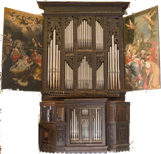
Santa Maria de Cadaquers, 1689-1691 Josep Boscà i Serinyena

Restauració i reconstrucció Gerhard Grenzing 1984

Enregistrament Huc Garcia Llorens

(de https://www.acorgue.cat/orgues/girona/alt-emporda/cadaques/santa-maria/):
L'orgue va ser construït entre 1689 i 1691 per Josep Boscà i Serinyena i essencialment es manté en la seva concepció original. La canonada metàl·lica la va reposar Gerhard Grenzing el 1984 car la perdé durant la Guerra Civil. El fet d'haver conservat a més de la caixa tants elements constituents, li dóna entitat suficient per a considerar-lo l'orgue més antic de Catalunya. Quan el 1689 pactà la construcció de l'orgue, s'acordà que havia de fer-lo de conformitat amb el que es trobava a l'església del convent de Sant Domènec de Girona, el primer que algú ha atribuït a les seves mans, encara que sembla més probable que fos de Bartomeu Triay.

Quan les portes posen al descobert la cara de l'orgue major, la de l'esquerra mostra l'adoració dels pastors i la de la dreta, l'adoració dels mags; quan les portes són tancades, s'ensenyen Jesús amb un deixeble i Adam i Eva, respectivament. Si la cortina de la cadireta està desenrotllada, s'observa una escena recurrent en les portes i cortines dels orgues: l'Anunciació.

L'orgue disposava d'una carassa, però actualment no hi és, ni tampoc el mecanisme per llençar llaminadures a la mainada; només en resta el forat per on devia passar una corda.

La present versió web virtual s'ha fet sobre els enregistraments fets per Huc Garcia Llorens amb el el motor descrit aquí.
S'hi han afegit opcions per a canviar-ne el diapasó així com per a fer-lo sonar en diversos tempraments històrics, així com un petit homenatge al llençament de llaminadures que sens dubte és una opció prou singular per un orgue d'església.

(from https://www.acorgue.cat/orgues/girona/alt-emporda/cadaques/santa-maria/):
The organ was built between 1689 and 1691 by Josep Boscà i Serinyena and essentially remains in its original design. The metal pipe was replaced by Gerhard Grenzing in 1984 because he lost it during the Civil War. The fact that so many constituent elements have been  preserved in addition to the case, gives it sufficient entity to consider it the oldest organ in Catalonia. When in 1689 he agreed to build the organ, he agreed that it should be made in accordance with the one found in the church of the convent of Sant Domènec in Girona, the first that someone has attributed to his hands, although it seems more likely that it was by Bartomeu Triay.

When the doors reveal the face of the main organ, the one on the left shows the adoration of the shepherds and the one on the right, the adoration of the magi; when the doors are closed, they show Jesus with a disciple and Adam and Eve, respectively. If the curtain of the chair is unrolled, a recurring scene can be seen on the doors and curtains of the organs: the Annunciation.

The organ had a carassa, but it is no longer there, nor is the mechanism for throwing sweets to the children; only the hole through which a string must have passed remains.

The present virtual web version has been made based on the recordings made by Huc Garcia Llorens with the engine described here.

Options have been added to change the tuning fork as well as to make it sound in various historical temperaments, as well as a small tribute to the candy throwing mechanism which is undoubtedly a rather unique option for a church organ.


Fotografia © 1992-2025 Associació Catalana de l'Orgue